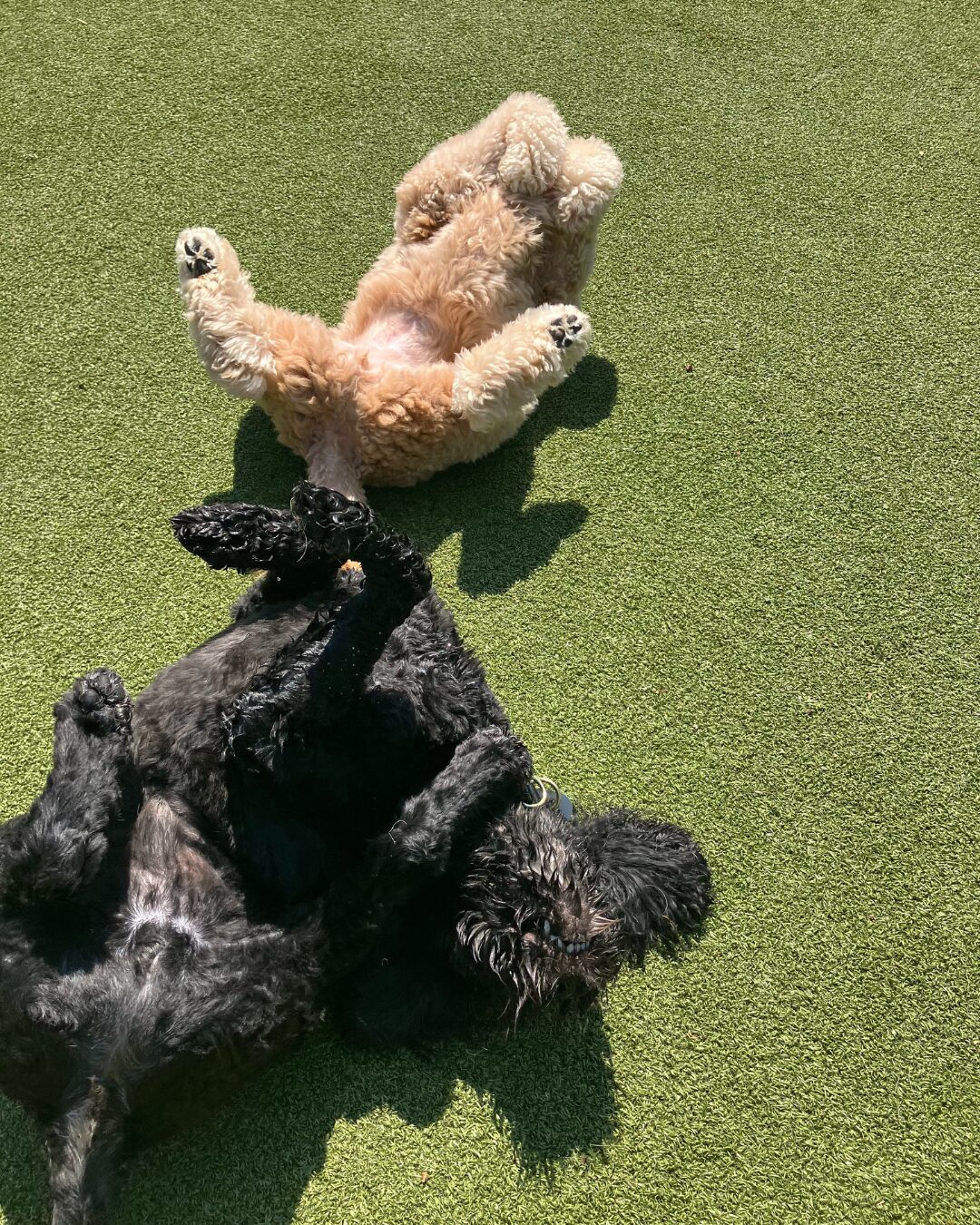

Have you ever watched your dog race across the play yard to greet one particular pup?
Maybe they always seem to find the same playmate at daycare. Maybe they light up when that familiar dog arrives. Or perhaps they ignore everyone else until their favorite companion walks through the gate.
It’s a question we hear often from pet parents at Best Friends Fur Ever:
“Does my dog actually have a best friend?”
The answer is fascinating.
While scientists don’t know whether dogs experience friendship exactly the same way humans do, decades of canine behavior research suggest that many dogs develop preferred social relationships with certain companions. In other words, your dog may very well have a favorite friend.


What Does the Science Say?
Dogs are highly social animals, but they don’t treat every relationship the same.
According to canine behavior researcher Dr. Ádám Miklósi, author of Dog Behaviour, Evolution, and Cognition, dogs form social relationships that are influenced by familiarity, personality, previous experiences, and individual preferences. Rather than interacting equally with every dog they meet, many dogs consistently choose to spend time with specific companions.
Researchers refer to these as preferred social relationships—dogs that naturally choose one another when given the opportunity.
While scientists avoid saying dogs experience friendship exactly as humans do, the behaviors they observe strongly suggest that many dogs develop meaningful social preferences.
How Do Dogs Choose Their Favorite Playmates?
It isn’t about breed. It isn’t about size. And it certainly isn’t random.
Dogs often choose companions based on compatibility.
Similar Play Styles
Some dogs love to wrestle. Others enjoy chasing games. Some are happiest exploring together, sniffing every corner of the yard.
Research by animal behaviorist Dr. Marc Bekoff, who has spent decades studying social play in dogs and wild canids, has shown that successful play depends on cooperation, communication, and compatible play styles.
Dogs who enjoy the same kind of play are much more likely to seek each other out again.
Similar Energy Levels
Have you ever noticed that puppies often find other puppies?
Or that senior dogs seem to enjoy calmer companions?
Dogs naturally gravitate toward playmates whose energy matches their own.
When energy levels are compatible, interactions tend to stay relaxed, balanced, and enjoyable for everyone involved.
Positive Experiences Build Trust
Friendships—whether human or canine—don’t happen instantly.
Dogs become more comfortable with one another through repeated positive experiences.
When two dogs consistently have fun together, they’re more likely to look for each other the next time they meet. Over time, those positive interactions can develop into a preferred social relationship.
Signs Your Dog May Have a Favorite Friend
Every dog is different, but many pet parents notice similar patterns.
Your dog may have a preferred companion if they:
- Head straight toward the same dog when they arrive.
- Consistently choose the same playmate even when other dogs are available.
- Take turns chasing, wrestling, or playing rather than one dog dominating the interaction.
- Frequently check in with one another during play.
- Choose to rest near each other during quieter moments.
- Become noticeably excited when reunited after time apart.
These behaviors don’t prove dogs experience friendship exactly like people—but they do suggest your dog enjoys that particular companion’s company.

Do Dogs Remember Their Dog Friends?
Yes.
Research suggests dogs have excellent long-term memories for familiar individuals.
Using scent, visual recognition, and previous experiences, dogs can recognize companions they’ve met before—even after weeks or months apart. Many pet parents have witnessed their dog enthusiastically greeting a familiar playmate after a long absence.
Scientists continue studying exactly how dogs experience these reunions emotionally, but there’s little question that dogs remember familiar companions.
Not Every Dog Wants Lots of Friends
Here’s something we remind pet parents every day: Not every dog wants to play with every other dog.
Just like people, dogs have unique personalities.
- Some love meeting everyone.
- Some prefer one or two familiar companions.
- Others would rather spend their day exploring with a trusted human than joining a large playgroup.
- All of those personalities are completely normal.
One of the biggest misconceptions about dog daycare is that every dog should enjoy the same type of social experience. In reality, the happiest dogs are often the ones whose day matches their personality.
What We See Every Day at Best Friends Fur Ever
One of the privileges of caring for Maryland dogs each week at our Joppa and Cockeysville dog daycare and boarding resorts is watching these relationships develop over time.
Our handlers regularly notice dogs who naturally seek each other out visit after visit. Sometimes it’s two energetic retrievers who can never get enough wrestling. Sometimes it’s two senior dogs who quietly enjoy exploring together.
Sometimes it’s a confident dog helping a newer, more reserved dog feel comfortable in a playgroup.
And sometimes it’s a dog who simply prefers spending the day with one of our handlers through Play My Way, enjoying puzzles, enrichment activities, sniffaris, and one-on-one attention instead of group play.
Those observations reinforce something we strongly believe:
Every dog deserves an experience designed around who they are—not who we expect them to be.


Why Matching Dogs Matters
At Best Friends Fur Ever, we don’t believe great daycare is about placing every dog into one large playgroup.
Instead, our trained handlers observe each dog’s:
- Play style
- Confidence level
- Energy
- Body language
- Social preferences
Those observations help us create experiences where dogs can feel safe, comfortable, and successful.
The Bottom Line
Science tells us that dogs are remarkably social animals capable of forming preferred relationships with familiar companions.
Whether we call those relationships “friendships” or “preferred social partners,” one thing is clear:
- Dogs are individuals.
- They have different personalities.
- Different preferences.
- Different social batteries.
And yes, many seem to have favorite companions they genuinely enjoy spending time with.
The next time your dog races across the yard to greet that one familiar face, they may just be saying hello to one of their favorite friends. We think that’s pretty special.

Frequently Asked Questions
Can dogs have best friends?
Research suggests many dogs develop preferred social relationships with familiar dogs. While scientists don’t know whether dogs experience friendship exactly the way humans do, many dogs consistently choose to spend time with specific companions.
Why does my dog only play with one dog?
Dogs often prefer companions with similar personalities, play styles, and energy levels. That’s a normal part of canine social behavior.
Is it okay if my dog doesn’t like every dog?
Absolutely. Just like people, dogs have different social preferences. Some enjoy large groups, while others are happiest with one or two companions—or even one-on-one time with people.
How do you know which dogs play well together?
Our trained handlers observe body language, confidence, play style, and social preferences to create positive experiences that help every dog succeed, whether they enjoy group play or individualized enrichment.
References
Bekoff, M. (2001). Social Play Behaviour: Cooperation, Fairness, Trust, and the Evolution of Morality. Journal of Consciousness Studies.
Bradshaw, J. W. S. (2011). Dog Sense: How the New Science of Dog Behavior Can Make You A Better Friend to Your Pet. Basic Books.
Horowitz, A. (2016). Being a Dog: Following the Dog into a World of Smell. Scribner.
Miklósi, Á. (2015). Dog Behaviour, Evolution, and Cognition (2nd ed.). Oxford University Press.